
Summary
- A new study reveals that Pakistan has cut in half the share of lead paint on the market since LEEP began its work there. LEEP and the Pakistan Standards & Quality Control Authority (PSQCA), in consultation with Pakistan Coating Association (PCA), conducted the study to examine shifts in how much of the market is still made up of lead paint. The results suggest that the market share of brands selling oil-based lead paint for home use has reduced from approximately 88% in 2021 to 41% in 2024.
- The progress was driven by major reformulation efforts: eight of Pakistan’s largest brands and 12 medium- and small-sized brands, which previously had high levels of lead, showed no detectable lead in the tested samples. These brands represent about 47% of the market, and the results suggest that they have switched to lead-free following LEEP’s engagement.
- Of the 59 remaining identified small- and medium-sized brands still found to be using lead, 16 of these brands are already working with LEEP to reformulate and move to lead-free products.
- We estimate that this reduction in lead paint will protect more than 7.5 million children from exposure to lead paint in their homes. This projection relies on modeling, with uncertainties around certain inputs including paint market growth rates, the percentage of homes using lead paint, and how quickly paint brands would have reformulated without our intervention. For more information on how we calculate impact please see our Cost Effectiveness Analysis explainer.
LEEP and PSQCA study in consultation with PCA
Pakistan is estimated to have the second highest level of childhood lead poisoning in the world. Lead exposure from paint and other sources affects approximately 47 million children in Pakistan, costing the country an estimated $38 billion in lost earnings every year. Pakistan has a legally binding limit on lead paint of 90 parts per million as recommended by the WHO and UNEP. In August and September of 2024, LEEP and PSQCA purchased 119 cans of home-use solvent-based paint from paint shops and hardware stores in Karachi, Sukkur, Quetta, Peshawar, Multan, Lahore, Rawalpindi and Islamabad. The study included one to two high-risk colours from each brand, matching the brands and colours sampled in previous studies and including any newly available brands. LEEP and PSQCA purchased additional cans from retailers in the eight urban centres where manufacturers had reformulated and distributed home-use, solvent-based paints in the market between October 2024 and September 2025. The study used the same testing method, inductively coupled argon plasma atomic emission spectrometry (ICP-AES), as in LEEP’s previous study in Pakistan with Aga Khan University.
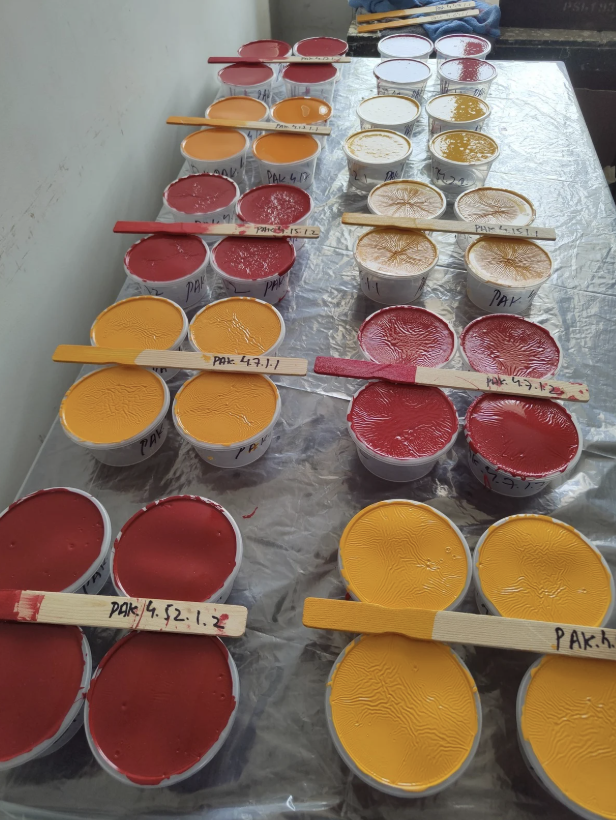
Paint samples tested for the paint study.
.
Paint Study Results
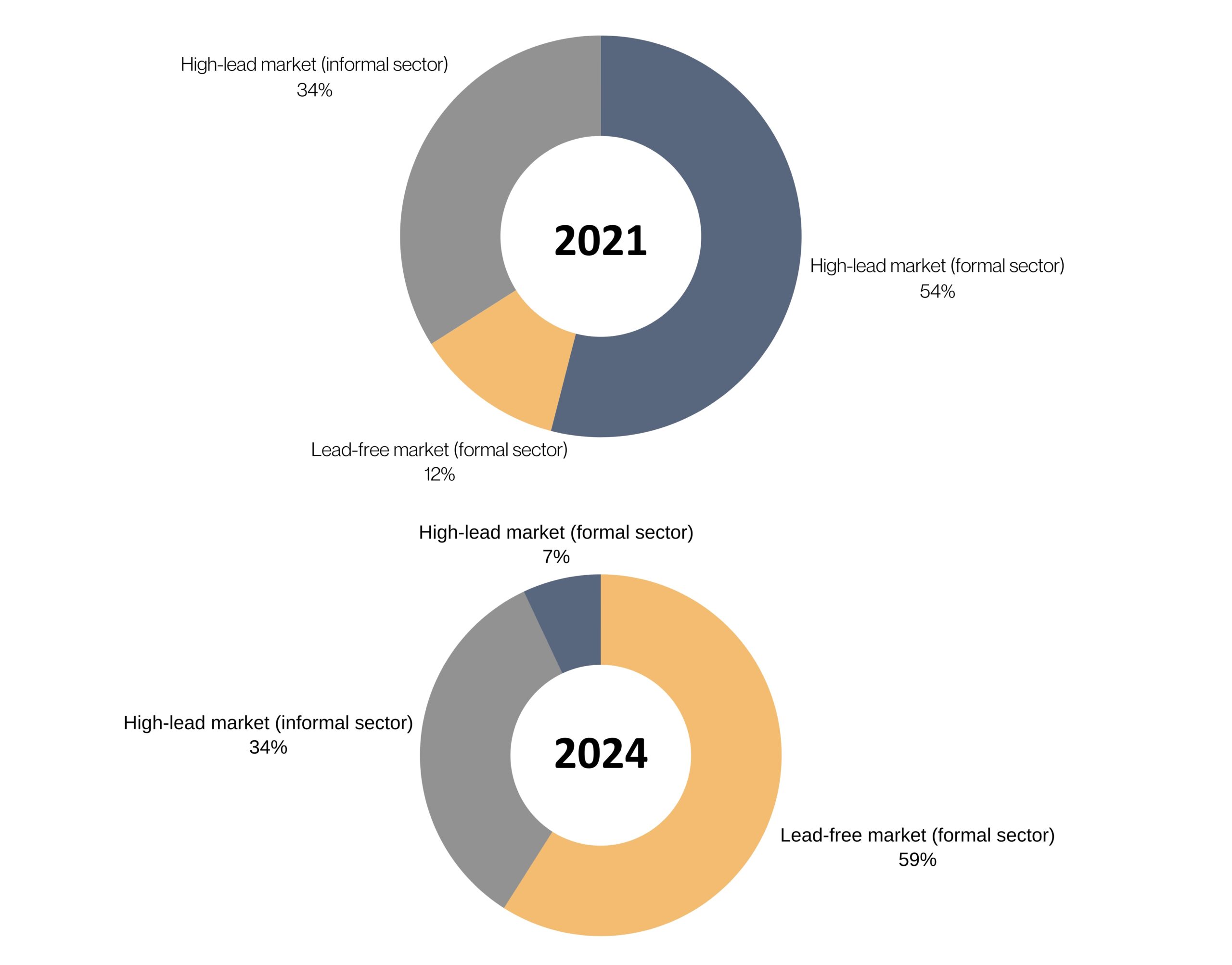
The research found that paint manufacturers have made progress towards ending the use of lead in Pakistan’s paint, with the study estimating that the market share of brands selling high-lead, oil-based paints for home use has fallen by more than half since 2021 – from 88% to 41%.
LEEP estimated each brand’s share of the entire oil-based paint market by volume, by conducting interviews with senior executives at major manufacturers and raw material suppliers in Pakistan, drawing insights from market intelligence reports, and carrying out supplemental desktop research. These estimates are approximate as there was no comprehensive market data available.
Estimated lead paint market in Pakistan in 2021 and 2024. Lead was not detected in samples tested from brands representing approximately 59% of the market.
Manufacturer Engagement
The study results suggest that Pakistan’s largest brands are no longer using lead. LEEP engaged with paint manufacturers in Pakistan to explain the health impacts of lead paint and how manufacturers can remove lead from their paint. We then identified replacement lead-free raw materials, in particular pigments, and have supported the manufacturers in finding supply routes for those materials in Pakistan. Our paint technologist has provided guidance on using the lead-free pigments, and we are offering free one-to-one technical support to manufacturers as they switch to those lead-free raw materials.
LEEP’s new study did not detect lead in the samples from 11 of Pakistan’s largest brands and 14 small- or medium-sized brands, with a total approximate market share of 59%. Of these, eight large brands and 12 small- or medium-sized brands, representing a total approximate market share of 47%, previously had high levels of lead, and reformulated following LEEP’s engagement. LEEP still found, though, that 59 smaller brands, accounting for approximately 7% of market share, were still using lead, and 16 of these brands are engaging with LEEP to move to lead-free. The remaining 34% of market share is estimated to be composed of informal manufacturers, and LEEP plans to engage with them and offer support to help them reformulate. The Pakistan Coating Association, the representative body of the country’s coating industry, has also called on manufacturers to move to lead-free, and LEEP continues to provide free technical support to manufacturers and carry out testing to confirm that manufacturers are switching to lead-free.
“Alhamdulillah, the paint industry of Pakistan is committed to protecting the health of children, and both large manufacturers and SMEs are taking steps toward eradicating lead in paint,” said Mr. Iftikhar Bashir Chaudhry, Chairman of the Pakistan Coating Association. “Eradicating lead from paint is technically and commercially feasible, and our customers appreciate our commitment to health and the environment.”
Government partnership
LEEP and PSQCA have worked in close partnership to address high levels of lead in paint since 2023. With support from LEEP in 2023, the PSQCA, the national standards body, revised the mandatory standard to restrict the level of lead in paint to 90 parts per million (ppm), and since receiving the results of the 2024 study, the PSQCA has been actively enforcing the mandatory national lead limit, issuing notices and recalls to non-compliant manufacturers.
“The PSQCA is firmly positioned to ensure nationwide compliance with mandatory standards that prohibit lead in paint and other products above acceptable range,” said Dr Sayeda Zia Batool, Director General of the Pakistan Standards & Quality Control Authority. “The reduction highlighted by this study proves that progress is achievable through persistent regulation and industry cooperation. We call upon all remaining manufacturers to immediately cease using lead-based raw materials, comply with the law, and help safeguard our population from this preventable harm.”
Media
Five media outlets in Pakistan covered the study results, including the News International, Business Recorder, Nukta Pakistan and Hum News.
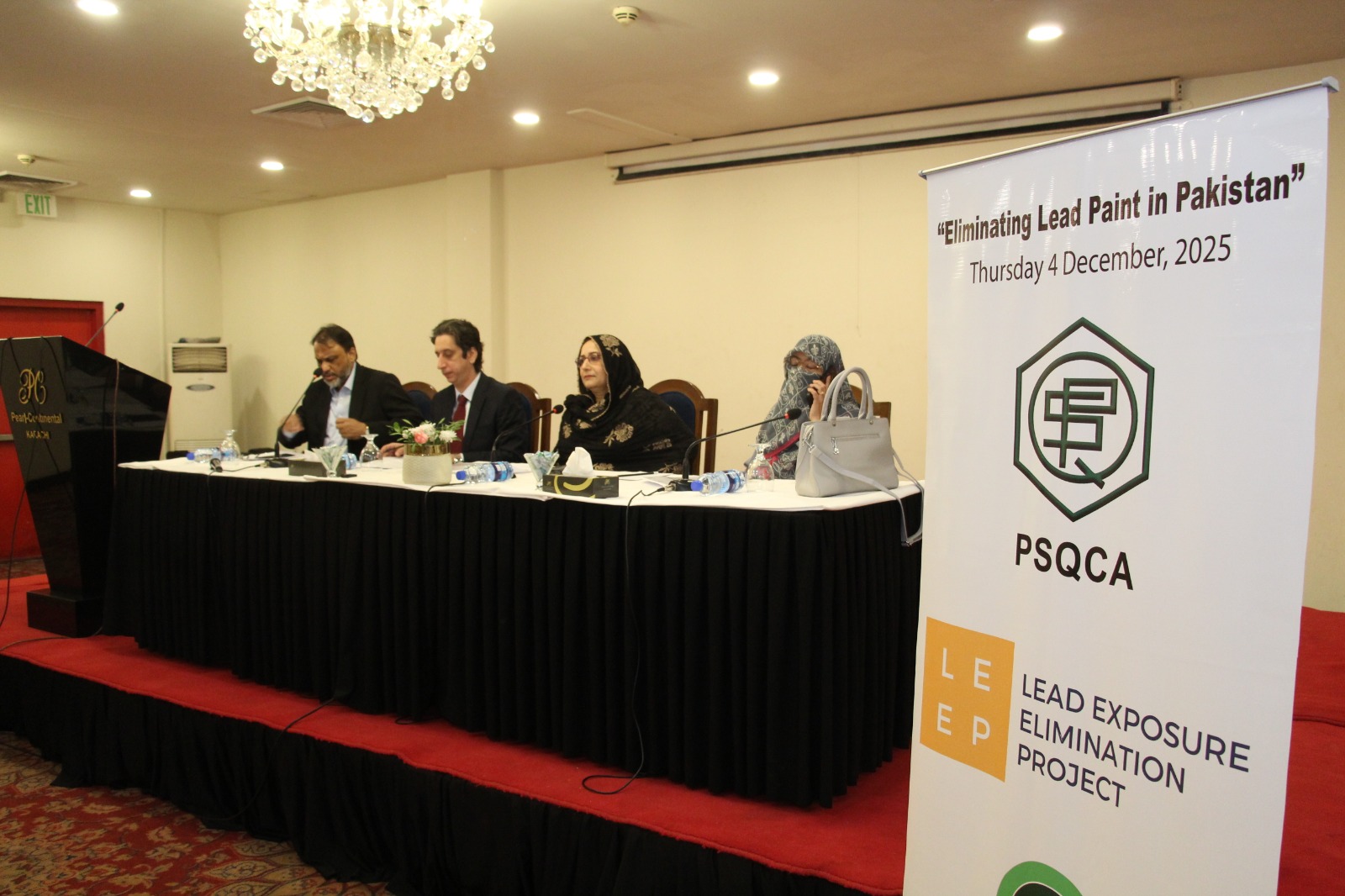
Caption: LEEP, PSQCA and PCA organized a press conference in Karachi on December 4, 2025 releasing the study results and calling on the remaining high-lead manufacturers to transition to lead-free.
Calculating Impact
We estimate that this reduction in lead paint will protect more than 7.5 million children from exposure to lead paint in their homes. We used a simplified version of our Cost Effectiveness Analysis model to estimate this number. The underlying assumption of our model is that our Pakistan program brings forward change on the lead paint market by five years. Our model calculates the difference between the estimated number of children born in homes with lead paint with and in the absence of our program.
Our calculation works as follows: first, we estimate how many children are born each year in homes that get painted, using annual births and urbanization data. Second, we focus only on children affected by market changes—those in newly painted homes (based on paint market growth) or homes getting repainted (using our estimates of how often repainting occurs). Third, we use the lead paint market share from our studies: our initial study provides our baseline estimate of what market share would be captured by lead paint without our program, while this new study shows the current reduced market share. The difference between these scenarios gives us our estimate of children protected.
Like any predictive model, this estimate involves uncertainties about certain inputs, such as paint market growth rates, repainting frequency, the percentage of homes using coloured solvent-based paints, and how quickly manufacturers would have reformulated without our intervention. While these uncertainties could affect our final estimate, we believe this model provides a credible estimate of the scale of impact achieved through the program. For more information on our assumptions and how we calculate impact please see our Cost Effectiveness Analysis explainer.
Acknowledgements
LEEP thanks PSQCA and PCA for their collaboration on this study.