
Summary
- New research reveals lead paint is widely available on the market in the Democratic Republic of the Congo (DRC). LEEP, in partnership with the DRC government, conducted the study in DRC’s most-populated cities, Kinshasa and Lubumbashi, and found 55% of samples tested contained hazardous levels of lead.
- In Kinshasa, 59% of samples exceeded the recommended limit of 90 ppm, with the highest concentration reaching 76,000 ppm. In Lubumbashi, 50% of samples exceeded the recommended limit, with the highest concentration reaching 50,000 ppm.
- As a result of these findings, the DRC took decisive regulatory action. In January, the DRC government’s National Standardization Committee officially adopted nine East African Community (EAC) standards on paints including a 90 ppm lead limit, along with ten complementary ISO standards, marking a major step toward eliminating hazardous lead paint from the Congolese market.
- The new regulation requires paint manufacturers to switch to lead-free raw materials. LEEP is now working directly with manufacturers, providing free technical assistance to help them reformulate their products, and plans to support the government with its enforcement efforts. This marks the first national effort in the DRC to address lead in paint. LEEP estimates this program may prevent lead paint exposure for 3.3 million children over the next 35 years. Like any predictive model, this estimate involves uncertainties about certain inputs. For more information on how we calculate impact please see our Cost Effectiveness Analysis explainer.
Paint study: sampling and analysis methods
LEEP in partnership with the Office Congolais de Contrôle (OCC), the government conformity assessment agency under the Ministry of Commerce, conducted two studies to determine the lead content of paints available on the market in the DRC. We conducted the first study in Kinshasa in July 2025, and the second in Lubumbashi in December 2025. A total of 84 paint samples were tested: 46 samples collected in Kinshasa and 38 samples collected in Lubumbashi.
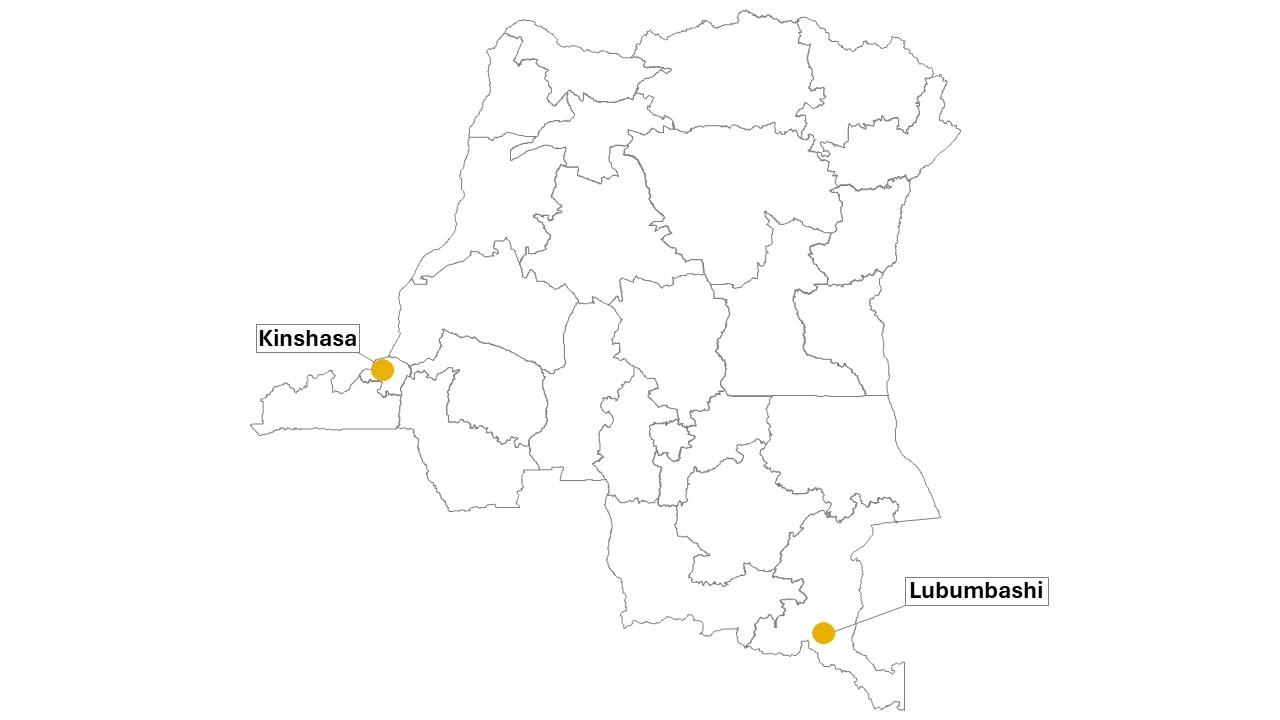
LEEP collected paint samples in DRC’s two most populated cities.
The paints were purchased from a wide range of retail outlets to ensure that the samples reflected what consumers can readily access. The products tested were primarily oil/solvent-based paints and tints, both intended for household use. We prioritised white, yellow, and red paints (when available).
As no accredited laboratory in the DRC currently exists to test lead in paint, we dried and shipped the paint samples to an accredited laboratory at the University of Wisconsin in the United States. The lab analysed the samples using inductively coupled plasma atomic emission spectroscopy (ICP-AES) to determine total lead concentration based on dry weight. The analytical methods used are consistent with those recommended by the WHO for measuring lead in paint.
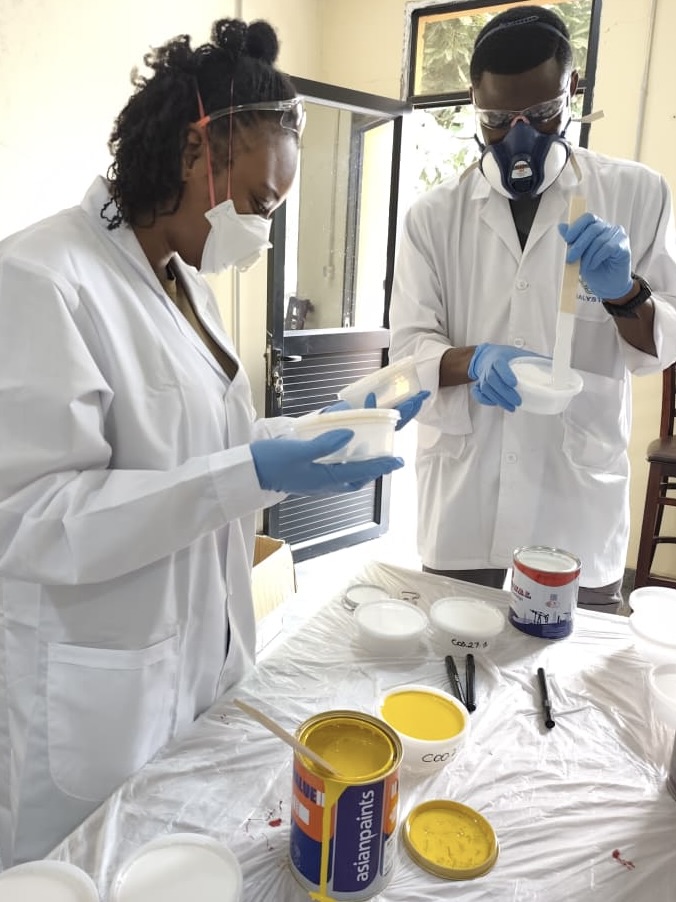
Conducting the paint study in Lubumbashi.
Paint study results
The paint study results showed that many paints contained lead levels that exceeded the WHO and UNEP recommended limit of 90 ppm. We tested 84 samples of paints and tints intended for home use in Kinshasa and Lubumbashi. The results showed that 46 of the 84 samples (55%) contained hazardous levels of lead above the recommended level.
- Kinshasa: 59% of samples exceeded 90 ppm, with the highest concentration reaching 76,000 ppm.
- Lubumbashi: 50% of samples exceeded 90 ppm, with the highest concentration reaching 50,000 ppm.
- Overall: 55% of all paints tested across both cities exceeded the recommended limit
A large proportion of paints contained extremely high levels of lead:
- In Kinshasa, 70% of samples that tested high lead (>90 ppm) exceeded 600 ppm.
- In Lubumbashi, 89% that tested high lead (>90 ppm) exceeded 600 ppm.
These dangerous levels pose serious risks to public health, particularly for children. Lead exposure from deteriorating paint can impair cognitive development, reduce educational attainment, and limit lifetime earning potential.
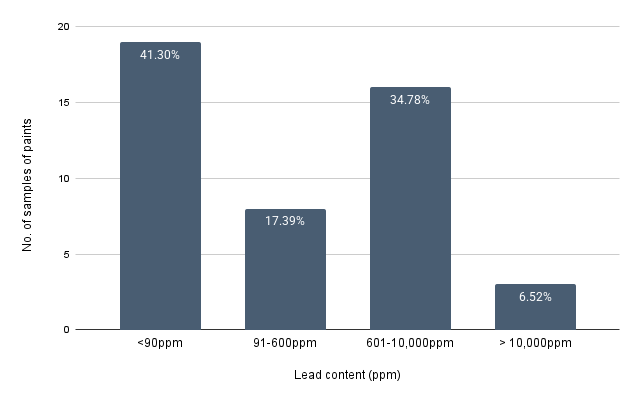
Lead content of the 46 samples of paints studied in Kinshasa. 90 ppm is the maximum limit recommended by the WHO and UNEP.
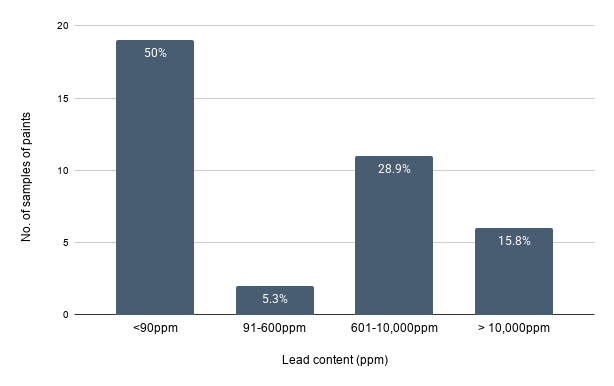
Lead content of the 38 samples of paints studied in Lubumbashi. 90 ppm is the maximum limit recommended by the WHO and UNEP.
The studies also revealed clear patterns in the origin of paints exceeding the 90ppm lead limit:
- In Kinshasa 63% of paints exceeding the limit were locally manufactured.
- In Lubumbashi 68% of paints exceeding the limit originated from the United Arab Emirates, 21% originated from DRC, and 11% from India.
These findings demonstrate that the problem in the DRC is both a domestic production issue and an import control issue. Effective regulation and enforcement must therefore address both locally manufactured and imported products. Importantly, non-lead paints were found in both cities. This demonstrates that the production and sale of lead-free paints is technically and economically feasible in the DRC.
View the paint sample analysis results for additional details.
New Regulation Adopted
Building on the evidence generated through the Kinshasa and Lubumbashi paint studies, LEEP supported the Ministry of Industry, through the National Standardization Committee (Comité National de Normalisation), in strengthening the regulatory framework for paints.
On January 13, 2026, the National Standardization Committee officially adopted:
- Nine East African Community (EAC) standards on paints, including a binding 90 ppm limit on total lead content, aligned with the UNEP and WHO recommendations; and
- Ten ISO standards, which complement the EAC standards and strengthen quality control, safety, and industrial compliance.
This milestone aligns the DRC with regional and international best practices and establishes a clear regulatory foundation for eliminating hazardous lead paints from the market.
The adoption of these standards represents a major milestone for public health protection, environmental safety, and industrial modernization in the DRC. The next critical step is to publish these standards in the official gazette and raise awareness among the relevant stakeholders. LEEP will continue to provide support to the government in the DRC for an effective implementation and enforcement of this new regulation to ensure full compliance.

LEEP conducted multiple workshops to present the paint study findings to key stakeholders and support the adoption of new lead paint regulation.
Supporting manufacturers to transition to lead-free
Following the release of the paint study results, the Office Congolais de Contrôle (OCC), in collaboration with LEEP, took proactive steps to engage the paint industry. The OCC issued formal notification letters to local manufacturers, communicating their specific laboratory results and highlighting cases of non-compliance. The letters included an invitation to participate in reformulation efforts and take advantage of LEEP’s technical support to transition toward compliant, lead-free paint production.
LEEP will continue to engage with the manufacturers to support reformulation using lead-free raw materials and to facilitate alignment with the newly adopted standards. This approach combines regulatory action with constructive industry engagement. The presence of compliant paints in both Kinshasa and Lubumbashi demonstrates that reformulation is achievable. Continued collaboration will be essential to ensure that all manufacturers and importers fully comply with the 90 ppm standard.
Calculating Impact
We estimate that this reduction in lead paint will protect more than 3.3 million children from exposure to lead paint in their homes. We used a simplified version of our Cost Effectiveness Analysis model to estimate this number. The underlying assumption of our model is that our DRC program brings forward change on the lead paint market by five years. Our model calculates the difference between the estimated number of children born in homes with lead paint with and in the absence of our program.
Our calculation works as follows: first, we estimate how many children are born each year in homes that get painted, using annual births and urbanization data. Second, we focus only on children affected by market changes—those in newly painted homes (based on paint market growth) or homes getting repainted (using our estimates of how often repainting occurs). Third, we use the lead paint market share from our studies: our initial study provides our baseline estimate of what market share would be captured by lead paint without our program, while this new study shows the current reduced market share. The difference between these scenarios gives us our estimate of children protected.
Like any predictive model, this estimate involves uncertainties about certain inputs, such as paint market growth rates, repainting frequency, the percentage of homes using coloured solvent-based paints, and how quickly manufacturers would have reformulated without our intervention. While these uncertainties could affect our final estimate, we believe this model provides a credible estimate of the scale of impact achieved through the program. For more information on our assumptions and how we calculate impact please see our Cost Effectiveness Analysis explainer.
Acknowledgements
LEEP expresses its sincere appreciation to:
- The Office Congolais de Contrôle (OCC) for its leadership in conducting the paint studies and engaging industry stakeholders;
- The Ministry of Industry and the National Standardization Committee for championing the adoption of the EAC and ISO standards that embed the 90 ppm lead limit;
- The technical teams and laboratory partners who ensured rigorous analysis; and
- All stakeholders committed to protecting children and communities from preventable lead exposure in the DRC.